DISCLAIMER:
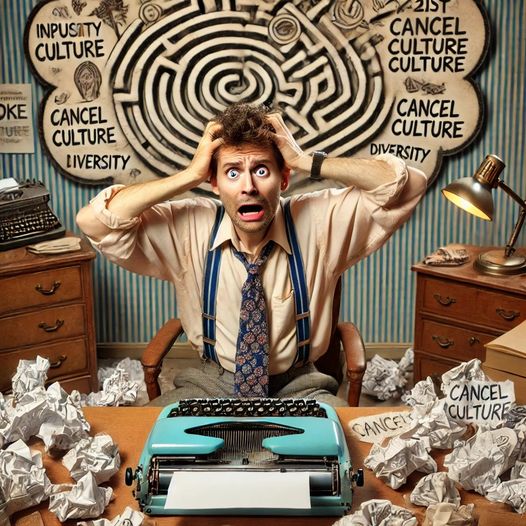
The following article is a work of fiction and an exploration of ideas through the lens of a character. Written in the first person, it is narrated by a comedy writer from the 1950s, he is not meant to reflect myself. Instead, this piece examines how this fictional writer might grapple with 21st-century Woke and Cancel culture, particularly in the context of how it affects his ability to be funny, to write, and to tell jokes. While all the events and examples mentioned are real, they occurred over the span of six decades to various individuals.
If some of the views expressed by this character seem offensive, I assure you that this was not written with the intent to upset. The goal is to present a character from another era, illustrating the stark differences between the times and inviting readers to reflect on what has changed—what we have gained and, perhaps, what we have lost. It is an experiment in perspective, designed to prompt thought rather than conflict, and written with a humble respect for the evolving nature of humor and culture.
The introduction took me longer to write than the following story.
Being a comedy writer today is like trying to bake a cake while constantly being told which ingredients are offensive. You’ve got the flour, sugar, and eggs all laid out, but then someone walks in and says, “Actually, flour is problematic,” and suddenly you’re staring at your recipe wondering if you’ll get canceled for making a joke about gluten.
Writing comedy used to be about finding the absurdities in life and making them funny. Now it feels like every joke comes with a list of side effects. It’s almost like writing a medical disclaimer: “Warning, this punchline may cause outrage, discomfort, or spontaneous social media boycotts. Consult your sensitivity advisor before reading.” And that’s because comedy, especially written comedy, is being taken way too seriously these days.
When I write a joke, my intent isn’t to make some profound moral statement or create a cultural movement—it’s to make people laugh. Simple, right? Well, not anymore. Somehow, jokes have become subject to the same scrutiny as political speeches or legal documents. What used to be a harmless punchline is now analyzed for its “problematic” undertones. And let me tell you, writing comedy in the age of “Woke society” is like trying to tap dance through a minefield while wearing clown shoes.
The issue is that people aren’t seeing jokes for what they are anymore: ““jokes”“. They’re analyzing every punchline like it’s part of a doctoral thesis on societal ethics. Take one of my recent scripts, for example. It was just a lighthearted sitcom scene about a guy who can’t find anything in the fridge. You know, classic joke about how we all somehow lose things in plain sight. Harmless, right? Well, no. Somewhere in the back of the room, a voice pipes up: “Isn’t this reinforcing negative gender stereotypes about men being helpless in domestic spaces?”
I blink. It’s not even about men being helpless—it’s about how fridges are chaos machines where food goes to disappear. But now, instead of the joke being funny, it’s been dissected into an academic discussion. How did we get here?
This isn’t to say that comedy can’t be smart, reflective, or conscious. It should be! But it’s becoming nearly impossible to write anything without someone somewhere taking it way too seriously. Comedy is built on exaggeration, on absurdity, on pushing boundaries and poking fun at life’s quirks. The key word there? “Fun”. But it feels like fun is getting harder to come by. Instead, everything’s being viewed through a microscope of moral judgment.
I’ve been in writers’ rooms where entire chunks of scripts are tossed out because “this joke could be misinterpreted.” The character’s reaction could be offensive, or the context might upset someone in some remote demographic. The end result? A lot of bland, vanilla jokes that barely push the envelope off the table, let alone across the room.
Writing comedy in the age of heightened social awareness often feels like playing a never-ending game of “what if.” What if this joke offends someone? What if this punchline is taken the wrong way? What if I inadvertently reinforce a stereotype? What if, what if, what if? Instead of focusing on what’s funny, we’re stuck obsessing over what’s safe. And let me tell you, safe is not funny.
This isn’t just about avoiding genuinely harmful content—of course, no one’s advocating for jokes that promote hate or discrimination. But when we start policing the harmless stuff—like a joke about how men are bad at multitasking or how women love shoes—it takes the joy out of the entire process. Remember when we used to laugh about things because they were relatable, not because we were endorsing some grand societal message? I miss those days.
And then there’s the issue of feminism and gender in comedy. I write a joke about a woman taking forever to get ready for a date, and suddenly it’s like I’ve just published a manifesto on the oppression of women. It’s a joke. One joke about a specific, exaggerated situation. But no, the analysis begins. “Aren’t you perpetuating the idea that women are obsessed with their appearance?” Well, maybe, but that’s because this particular character “is” obsessed with their appearance. It’s called character development, not a commentary on all women. But nuance is dead, it seems. We’re too busy dissecting every line like it’s Shakespeare, forgetting that sometimes a joke is just supposed to be funny.
And it’s not just about gender or identity politics. Writing about anything can trigger a similar response. You can make a joke about literally anything—jobs, food, technology—and someone, somewhere, will be ready to call it out as problematic. I wrote a joke about how no one reads emails anymore, and guess what? I got feedback that it was “alienating” to people who rely on email for important communication. How did we get to the point where a joke about emails is considered a commentary on human connectivity?
Social media has made it worse. Every time I write a piece of dialogue or a funny scene, there’s a part of my brain that starts imagining the Twitter threads it might spark. I can already see the hashtags. One poorly worded joke, one slight misstep, and you’re trending for all the wrong reasons. Forget about the fact that the joke wasn’t meant to hurt anyone—the fact that it “could” be interpreted as hurtful is enough to sink it.
This constant fear of backlash has writers second-guessing every word they put on the page. We’re not just crafting jokes; we’re crafting disclaimers. “Here’s a punchline, but just so you know, this is in no way reflective of my personal views or beliefs, and if anyone is offended, I sincerely apologize in advance.” It’s exhausting. Comedy writing has turned into this strange balancing act where we’re trying to be funny while making sure that no one, anywhere, at any time, could possibly misinterpret our jokes as something sinister.
It’s ironic, really. Comedy used to be one of the few places where we could explore difficult topics through laughter, where we could poke fun at our own flaws and see the humor in life’s chaos. But now, it feels like the last place you can be “honest”. Everything has to be sanitized for public consumption, stripped of any edge that might raise an eyebrow.
And don’t even get me started on writing for TV or movies. You think it’s tough in a comedy club? Try pitching a joke in a writers’ room. It’s like navigating a maze of sensitivity training courses. I once had a scene where a character was trying to assemble IKEA furniture, a classic setup for a joke. But someone raised their hand and said, “Does this joke subtly reinforce stereotypes about Scandinavians and efficiency?” I didn’t even know how to respond.
Writing comedy today feels like you’re constantly playing defense. You’re not just writing to get laughs, you’re writing to avoid getting criticized, and that changes everything. It stifles creativity and makes everything feel like it’s wrapped in bubble wrap. Comedy is supposed to take risks, but now it’s all about calculated, measured, triple-checked-for-offense risks.
At the end of the day, comedy is meant to make us laugh, to relieve the pressure of life’s stresses and absurdities. But if we’re constantly worried about who might take offense, the punchlines lose their punch. The truth is, if you analyze any joke long enough, you’ll find something to be upset about. But if we can’t laugh at the small things—at ourselves, at the world—then what are we left with? Probably a lot of awkward silences.
So, here’s my plea: next time you read or hear a joke, before you start writing your 12-part Twitter thread about why it’s problematic, stop and ask yourself, “Was this meant to be funny?” If the answer is yes, maybe just enjoy it for what it is. Because in the end, sometimes a joke is just a joke, and we could all use a little more laughter.


Leave a Reply